Conditions of Sale
By submitting your bid, you agree that:
You have read and agree with the Auction Terms and Conditions below and the Invaluable Terms of Use Agreement.
You agree to pay a buyer's premium of a total of 25% plus any applicable taxes, shipping and administration fees. This amount will be included in your invoice issued by University Archives after the conclusion of the auction. We accept credit cards for payment for any winning online bidders at all sales. We require credit card information to bid, and may use it for payment if you are the winning bidder. Lots purchased will come with a printed Auction Certificate and a description of the item. IF ITEMS ARE PICKED UP AT OUR CT OFFICES, CT SALES TAX WILL BE CHARGED. Any applicable state sales taxes will also be charged. Updates will follow as necessary, including shipping and administration fees. Delivery of purchased items will not be made unless and until full payment has been received by University Archives, i.e., check or credit card funds or other methods have fully cleared. University Archives now participates in Invaluable Payments in addition to Live Payments. Bidders will be able to pay directly for auction items using Invaluable, AuctionZip, and LiveAuctioneers platforms. We are required by law to charge applicable state sales taxes for items won that are shipped within all of the United States. State sales tax will be added to all domestic invoices. State sales tax will be collected by Invaluable payments and Live Payments in 45 states (excluding Alaska, Delaware, Montana, New Hampshire, Oregon.)
BUYER'S PREMIUM
A total of a 25% buyer's premium will be added to the hammer price on all individual lots sold.
Full Terms & Conditions of Sale
Payment in full is due within five (5) calendar days of the invoice date. If payment is not made within 5 calendar days of the date of the invoice, we will charge the buyer's credit card on file on the 6th calendar day. For LiveAuctioneers bidders, payment in full is due within seventy-two (72) hours of the invoice date. If payment is not made within 72 hours of the date of the invoice, LiveAuctioneers will charge the buyer's credit card on file.***PLEASE NOTE: IF YOU WOULD LIKE YOUR SHIPMENT TO BE SENT TO AN ADDRESS OTHER THAN THE ONE YOU HAVE ON FILE WITH YOUR BIDDING PLATFORM, YOU WILL NEED TO INFORM US OF THIS AS SOON AS PAYMENT IS SUBMITTED FOR YOUR WINNINGS***
We accept credit cards for payment for any winning online bidders at all sales. We require credit card information to bid, and may use it for payment if you are the winning bidder. A total of a 25% buyer's premium will be added to the hammer price on all individual lots sold, except if you are bidding on LiveAuctioneers, in which case the buyer's premium is 28%. Any applicable state sales taxes will also be charged. Updates will follow as necessary, including shipping and administration fees. Delivery of purchased items will not be made unless and until full payment has been received by University Archives, i.e., check or credit card funds or other methods have fully cleared. University Archives now participates in Invaluable Payments in addition to Live Payments. Bidders will be able to pay directly for auction items using Invaluable, AuctionZip, and LiveAuctioneers platforms. We are required by law to charge applicable state sales taxes for items won that are shipped within all of the United States. State sales tax will be added to all domestic invoices. State sales tax will be collected by Invaluable payments and Live Payments in 45 states (excluding Alaska, Delaware, Montana, New Hampshire, Oregon.)
Buyer's Premium: A total of a 25% buyer's premium will be added to the hammer price on all individual lots sold, except if you are bidding on LiveAuctioneers, in which case the buyer's premium is 28%.
Full Terms & Conditions of Sale: Payment & Shipping
Payment
Payment in full is due within five (5) calendar days of the invoice date. If payment is not made within 5 calendar days of the date of the invoice, we will charge the buyer's credit card on file on the 6th calendar day. For LiveAuctioneers bidders, payment in full is due within seventy-two (72) hours of the invoice date. If payment is not made within 72 hours of the date of the invoice, LiveAuctioneers will charge the buyer's credit card on file. ***Please Note: If you would like your shipment sent to an address other than the one appearing on your invoice, please inform us as soon as your payment is submitted.***
We accept Credit Cards (American Express, Visa, Discover, Master Card), Personal Check, Wire Transfer, Money Order, Cashier's Check, as payment for any winning bidders at all sales. We require credit card information to bid, and may use it for payment if you are the winning bidder.
Shipping
We do our own in-house world-wide shipping! Applicable shipping, handling and insurance charges will be added to the invoice. We offer several shipping options, and remain one of the few auction houses that proudly provides professional in-house shipping as an option to our clients. All items will ship with a signature required option, and full insurance. Most items are sent via Federal Express, with P. O. Box addresses being sent through USPS. We insure through Berkley Asset Protection with rates of $.70 per $100 of value, among the lowest insurance rates in the industry. Our shipping department cameras document every package, both outgoing and incoming, for maximum security. In addition, we compare our shipping and handling rates against those of other auction houses, to ensure that our charges are among the lowest in the trade.
International shipments: In order to comply with our insurance provider, all international shipments will be sent via Fed Ex and customs paperwork will show a value of $1.00. International buyers should contact our office directly with any questions regarding this policy.
Upon winning your item(s), you will receive an invoice with our in-house shipping and handling fees included (except for local pickup in Connecticut.) Any applicable state sales taxes will also be charged. Updates will follow as necessary, including shipping and administration fees. Delivery of purchased items will not be made unless and until full payment has been received by University Archives, i.e., check or credit card funds or other methods have fully cleared. University Archives now participates in Invaluable Payments in addition to Live Payments. Bidders will be able to pay directly for auction items using Invaluable, AuctionZip, and LiveAuctioneers platforms. We are required by law to charge applicable state sales taxes for items won that are shipped within all of the United States. State sales tax will be added to all domestic invoices. State sales tax will be collected by Invaluable payments and Live Payments in 45 states (excluding Alaska, Delaware, Montana, New Hampshire, Oregon.)
Third-Party Shipping Option: If a third-party shipper is preferred, the buyer is responsible for contacting the shipper directly to make shipping arrangements. For your convenience, we have provided some recommended shippers. For your protection, we will require a signed release from you, confirming your authorization for us to release your lots to your specified third-party. Once the lots have been picked up by the shipper, our responsibility and insurance coverage for your item(s) ceases. Items picked up by third-party shippers are required to pay Connecticut sales tax. Items that require third-party shipping because they are oversized, fragile or bulky, will show this information clearly in the auction description. Please see our full Terms and Conditions for more details, and names of suggested third-party shippers.
After payment has been made in full and funds have cleared our bank, University Archives will ship your purchase within 10 business days following receipt of full payment for items. International buyers will be responsible for any customs duties, fees and taxes incurred.
Please remember that the buyer is responsible for all shipping costs from the offices of University Archives in Wilton, CT to the buyer's door. Please see full Terms and Conditions of Sale.
Terms and Conditions
Buyer's Premium
25% for absentee and phone bids as well as internet bids placed on our website, Invaluable, and AuctionZip. 28% buyer's premium for any internet bids placed on LiveAuctioneers.
From: To: Increment:
$0 $99 $10
$100 $299 $20
$300 $499 $25
$500 $999 $50
$1,000 $1,999 $100
$2,000 $2,999 $200
$3,000 $4,999 $250
$5,000 $9,999 $500
$10,000 $19,999 $1,000
$20,000 $49,999 $2,500
$50,000+ $5,000
PAYMENT: Payment in full is due within five (5) calendar days of the invoice date. If payment is not made within 5 calendar days of the date of the invoice, we will charge the buyer's credit card on file on the 6th calendar day. For LiveAuctioneers bidders, payment in full is due within seventy-two (72) hours of the invoice date. If payment is not made within 72 hours of the date of the invoice, LiveAuctioneers will charge the buyer's credit card on file.***Please Note: If you would like your shipment sent to an address other than the one appearing on your invoice, please inform us as soon as your payment is submitted.***
We accept Credit Cards (American Express, Visa, Discover, Master Card), Personal Check, Wire Transfer, Money Order, Cashier's Check, as payment for any winning bidders at all sales. We require credit card information to bid, and may use it for payment if you are the winning bidder.
BUYER'S PREMIUM: A total of a 25% buyer's premium will be added to the hammer price on all individual lots sold except if you are bidding on LiveAuctioneers, in which case the buyer's premium is 28%. Items picked up at our offices in Connecticut will also be charged the mandatory Connecticut sales tax. Shipping, handling and insurance fees will be included on lots. Delivery of purchased items will not be made unless and until full payment has been received by University Archives, and funds have fully cleared our bank. If paying using a credit card on file with the internet auction site, please note that we reserve the right to charge your credit card if you have not made payment within 5 calendar days post auction.
Full Terms & Conditions of Sale: University Archives Terms and Conditions of Sale
ANYONE EITHER REGISTERING TO BID OR PLACING A BID ("BIDDER") ACCEPTS THESE CONDITIONS OF SALE AND ENTERS INTO A LEGALLY, BINDING, ENFORCEABLE AGREEMENT WITH THE UNIVERSITY STAMP COMPANY, INC., HEREINAFTER KNOWN AS "UNIVERSITY ARCHIVES" TOGETHER WITH BIDDER, THE "PARTIES"
The following terms and conditions ("Conditions of Sale") constitute the sole terms and conditions under which University Archives will offer for sale and sell the property described in the catalog of items for auction (the "Catalog"). These Conditions of Sale constitute a binding agreement between the Parties with respect to the auction in which the Bidder participates (the "Auction"). By bidding at the Auction, whether in person, through an agent or representative, by telephone, online, absentee bid, or by any other form of bid or by any other means, Bidder acknowledges the thorough reading and understanding of all of these Conditions of Sale, all descriptions of items in the Catalog, and all matters incorporated herein by reference, and agrees to be fully bound thereby. This acknowledgement is a material term of these Conditions of Sale and of the consideration under which University Archives agrees to these terms.
This Auction is presented by University Archives. Internet sites are "universityarchives.com", "Invaluable.com" , "AuctionZip" and "LiveAuctioneers.com." The Auction is conducted under these Conditions of Sale.
The Bidder: Bidder shall mean the original Bidder on the property offered for sale by University Archives and not any subsequent owner or another person who may acquire or have acquired an interest therein. If Bidder is an agent, the agency must be disclosed in writing to University Archives prior to the time of sale, otherwise, the benefits of the warranty shall be limited to the agent and not transferable to the undisclosed principal.
The rights granted to Bidder under these Conditions of Sale are personal and may not be assigned or transferred to any other person or entity, whether by operation of law or otherwise without the express written assent of University Archives. Bidder may not transfer, assign, or otherwise convey these Conditions of Sale or any of the rights herein, and such purported transfer, assignment, or conveyance shall be null and void. No third-party may rely on any benefit or right conferred on any Bidder by these Conditions of Sale, and no third-party is intended as a beneficiary of these Conditions of Sale.
Bids will not be accepted from minor persons under eighteen (18) years of age without a parent's written consent containing an acknowledgment of the Conditions of Sale herein and indicating their agreement to be bound thereby on behalf of the Bidder.
All Bidders must meet University Archives' qualifications to bid. Any Bidder who is not a client in good standing of University Archives may be disqualified at University Archives' sole option and will not be awarded lots. Such determination may be made by University Archives in its sole and unlimited discretion, at any time prior to, during, or even after the close of the Auction. University Archives reserves the right to exclude any person from the Auction.
If an entity places a bid, then the person executing the bid on behalf of the entity agrees to personally guarantee payment for any successful bid.
By accepting the Conditions of Sale, Bidder personally and unconditionally guarantees payment.
Bidding: Each Bidder's determination of its bid should be based upon its own examination of the item(s) online. In any purchase or sale, the value of the item(s) is determined by the price. THE BIDDER HEREBY ASSUMES ALL RISKS OF VALUATION CONCERNING ANY AND ALL PURCHASES. UNIVERSITY ARCHIVES IS NOT RESPONSIBLE FOR ERRORS IN BIDDING. A Bidder should make certain to bid on the correct lot and that the bid is the maximum (plus the buyer's premium) that the Bidder is willing and able to pay. Since other Bidders online will be present, and since a re-offering could damage the momentum of the sale, once the hammer has fallen and University Archives has announced the winning Bidder, such Bidder is unconditionally bound to pay for the lot, even if the Bidder has made an error.
Title to any lot remains with Consignor, any secured party of the Consignor, or assignee of Consignor, as the case may be, until the lot is paid for in full by Bidder. University Archives reserves the right to require payment in full before delivering any lot to the successful Bidder.
It is the Bidder's responsibility and obligation to have the lots fully insured while in their possession. Bidder assumes any and all RISK OF LOSS once the lot(s) is in Bidder's possession.
Bidder grants to University Archives or its assigns the right to offset any sums due, or found to be due by University Archives, and to make such offset from any past, subsequent or future consignment, or items acquired by Bidder in possession or control of University Archives or from any sums due to Bidder by University Archives. Bidder further grants University Archives a purchase money security interest in such sums or items to the extent applicable, and agrees to execute such documents as may be reasonably necessary to grant University Archives such security interest. Bidder agrees that University Archives and its assigns shall be a secured party with respect to items bought by Bidder and in the possession of University Archives, to the extent of the maximum indebtedness, plus all accrued expenses, until the indebtedness is paid.
By bidding in this sale, Bidder personally and unconditionally guarantees payment.
In the event of a successful challenge to the title to any goods purchased pursuant to these Conditions of Sale and the exclusive remedies provided herein, University Archives agrees to reimburse any Bidder in an amount equal to the successful bid price actually paid by Bidder at auction plus any buyer's premium actually paid, in full and complete satisfaction of all claims, which once tendered by University Archives, relieves and releases University Archives from any responsibility whatsoever to the Bidder, even if the instrument is not cashed or is returned.
Because Invaluable.com, AuctionZip.com, and LiveAuctioneers.com act only as agents, all bids submitted directly to the house are always given preference in the event of a tie. Absentee bids submitted via internet bidding services are not known to the auctioneer until the lot is opened on the day of the Auction.
In all Auctions, bids on an item must raise the current high bid according to University Archives bidding increments specified under Auction Terms, on a per-Auction basis. Bids will be accepted in whole dollar amounts only. No "buy" or "unlimited" bids will be accepted. In a live sale, bids on an item can change at the discretion of University Archives.
University Archives will record the paddle number of the Bidder. If Bidder's absentee bid is successful, Bidder will be notified after the sale by mailed or emailed invoice.
University Archives reserves the right to accept or decline any bid. Bids must be for an entire lot and each lot constitutes a separate sale. All bids are per lot unless otherwise announced. Live auction lots will be sold in their numbered sequence unless University Archives directs otherwise. It is unlawful and illegal for Bidders to collude, pool, or agree with another Bidder to pay less than the fair value for lot(s). For live auctions, University Archives will have final discretion in the event that any dispute should arise between Bidders. University Archives will determine the successful Bidder, cancel the sale, or re-offer and resell the lot or lots in dispute. University Archives will have final discretion to resolve any disputes arising after the online auction. If any dispute arises, University Archives' sale record is conclusive.
University Archives shall determine opening bids and bidding increments. University Archives has the right in its absolute discretion to reject any bid in the event of dispute between Bidders or if University Archives has doubt as to the validity of any bid, to advance the bidding at its absolute discretion and to determine the successful Bidder in the event of a dispute between Bidders, to continue the bidding or to re-offer and resell the lot in question. In the event of a dispute after the sale, University Archives' record of final sale shall be conclusive. University Archives also may reject any bid if University Archives decides either that any bid is below the reserve of the lot or article or that an advance is insufficient. Unless otherwise announced by University Archives at the time of sale, no lots may be divided for the purpose of sale.
Bidder may open, monitor, and/or raise bids at any time before the close of a lot through universityarchives.com, Invaluable.com, AuctionZip.com, or LiveAuctioneers.com. To ensure proper registration, those Bidders intending to bid via the Internet must visit universityarchives.com, Invaluable.com or AuctionZip.com or LiveAuctioneers.com and register accordingly at least one full day prior to the actual auction. Winning bidders will be notified by University Archives. University Archives is not responsible or liable for any problems, delays, or any other issues or problems resulting out of use of the Internet generally or specifically, including but not limited to transmission, execution or processing of bids.
Property is auctioned in consecutive numerical order, as it appears in the online auction catalog. The auctioneer will accept bids from absentee bidders participating by internet or by written bid left with University Archives in advance of the auction. The auctioneer may also execute a bid on behalf of the consignor, the owner, or the house to protect the reserve, by entering a bid in response to absentee bids. Under no circumstances will the auctioneer place any bid on behalf of the consignor above the reserve which is never above the low estimate. The auctioneer will not specifically identify bids placed on behalf of the consignor to protect the reserve.
University Archives is not responsible or liable for any problems, delays, or any other issues or problems resulting out of use of the Internet generally or specifically, including but not limited to transmission, execution or processing of bids.
To maximize Bidder's chance of winning, University Archives strongly encourages the use of maximum bids. University Archives will then bid for Bidder until the lot reaches Bidder's specified maximum. Maximum bids are strictly confidential.
Absentee bids (advance written bids submitted prior to start of the auction) are offered solely as a convenience and permitted only prior to the start of the online auction, with University Archives' approval which shall be exercised at University Archives' sole discretion. Neither University Archives nor its agents or employees shall be held liable for the failure to execute bids or for errors relating to any transmission or execution thereof. In order to be considered for advance bidding in any manner, Bidders must comply with all of these Conditions of Sale and the terms contained on the Registration Form.
Buyer's Premium: The Bidder acknowledges and agrees that a total of a 25% buyer's premium will be added to the hammer price on all individual lots sold, except for those bidding on LiveAuctioneers, in which the buyer's premium is 28%. Delivery of purchased items will not be made unless and until full payment has been received by University Archives via check or credit card or other funds which have fully cleared. Unless otherwise agreed in writing, signed by University Archives, payment in full is due within five (5) calendar days of the invoice date. For LiveAuctioneers bidders, payment in full is due within seventy-two (72) hours of the invoice date. If payment is not made within 72 hours of the date of the invoice, LiveAuctioneers will charge the buyer's credit card on file. University Archives' buyer's Premium does not include any fees assessed by third-party internet bidding platforms. Please refer to the internet bidding platform's terms and conditions for any additional premium charged.
Payment: Subject to fulfillment of all of the Conditions of Sale set forth herein, upon the sooner of (1) the passing of title to the offered lot pursuant to these Conditions of Sale, or (2) possession of the offered lot by the Bidder, Bidder thereupon (a) assumes full risk and responsibility (including without limitation, liability for or damage to frames or glass covering prints, paintings, photos, or other works), and (b) will immediately pay the full purchase price or such part as University Archives may require.
Payment is due upon presentation of an invoice, following the end of auction. University Archives reserves the right to void an invoice if payment in full is not received within five (5) calendar days of the of the invoice date. In cases of nonpayment, University Archives' election to void a sale does not relieve the Bidder from their obligation to pay University Archives its fees (seller's and buyer's Premium) on the lot and any other damage pertaining to the lot. For LiveAuctioneers bidders, payment in full is due within seventy-two (72) hours of the invoice date. If payment is not made within 72 hours of the date of the invoice, LiveAuctioneers will charge the buyer's credit card on file.
We accept credit cards for payment for any winning online bidders at all sales. We require credit card information to bid. If payment is not made within 5 calendar days of the date of the invoice, we will charge the buyer's credit card on file on the 6th calendar day. For LiveAuctioneers bidders, payment in full is due within seventy-two (72) hours of the invoice date. If payment is not made within 72 hours of the date of the invoice, LiveAuctioneers will charge the buyer's credit card on file.
The Parties consent to the enforcement of the decision in the Arbitration pursuant to the Federal Arbitration Act in either the courts of the State of Connecticut or the United States District Court for the Stamford - Norwalk Judicial District. All Bidders and Buyers agree to be subject to jurisdiction in the county and state where the auctioneer is located (Wilton, Connecticut, USA), which should be the exclusive venue for dispute resolution.
Attorney's Fees. In the event of a legal dispute related to the Bidder's failure to pay for auction items, University Archives will be entitled to attorneys' fees incurred in collecting monies owed.
No Chargebacks Provision. As a condition to registration and bidding, the Bidder agrees and acknowledges that they will not, under any circumstances, initiate a credit card chargeback, and that they are waiving any such rights that may exist under the agreement between the Bidder and the Bidder's credit card company. Only when the Bidder agrees to this will the auctioneer allow the Bidder to register and bid. Furthermore, Bidders agree and acknowledge that, should a chargeback be initiated by the Bidder, the Bidder terms and conditions will be conclusive evidence of the Bidder's waiver of any chargeback rights. Even if a chargeback is successful, the Bidder remains liable for the purchase price, plus costs of collection, including attorneys' fees.
All payments for sales are strictly in U.S. dollars via credit cards, personal checks, cashier checks, bank money orders and wire transfers, and are subject to all reporting requirements.
All deliveries are subject to good funds; funds being received in University Archives' account before delivery of the Purchases; and all payments are subject to a clearing period. University Archives reserves the right to determine if a check constitutes "good funds": checks drawn on a U.S. bank are subject to a ten (10) calendar day hold, and ten (10) business days when drawn on an international bank.
In the event that a Bidder's payment is dishonored upon presentment(s), Bidder shall pay the maximum statutory processing fee set by applicable state law. If Bidder attempts to pay via check and the financial institution denies the transfer from Bidder's bank account, or the payment cannot be completed using the selected funding source, Bidder agrees to complete payment.
If University Archives refers any invoice to an attorney for collection, the Bidder agrees to pay attorney's fees, court costs, and other collection costs incurred by University Archives. If University Archives assigns collection to its house counsel, such attorney's time expended on the matter shall be compensated at a rate comparable to the hourly rate of independent attorneys.
University Archives shall have a lien against the merchandise purchased by the Bidder to secure payment of the Auction invoice. University Archives is further granted a lien and the right to retain possession of any other property of the Bidder then held by University Archives or its affiliates to secure payment of any Auction invoice or any other amounts due University Archives or affiliates from the Bidder. With respect to these lien rights, University Archives shall have all the rights of a secured creditor, including but not limited to the right of sale. In addition, with respect to payment of the Auction invoice(s), the Bidder waives any and all rights of offset he might otherwise have against University Archives and the consignor of the merchandise included on the invoice (the "Consignor"). If a Bidder owes University Archives or its affiliates on any account, University Archives and its affiliates shall have the right to offset such unpaid account by any credit balance due Bidder, and it may secure by possessory lien any unpaid amount by any of the Bidder's property in their possession. Title shall not pass to the successful Bidder until all invoices are paid in full. All checks, cashier's checks, bank checks, or money orders are payable to University Archives.
Shipping: Applicable shipping, handling and insurance charges will be added to the invoice. We offer several shipping options, and remain one of the few auction houses who proudly provides professional in-house shipping as an option to our clients. All items will ship with a signature required option, and full insurance. Most items are sent via Federal Express, with P. O. Box addresses being sent through USPS. We insure through Berkley Asset Protection with rates of $.70 per $100 of value, among the lowest insurance rates in the industry. Our shipping department cameras document every package, both outgoing and incoming, for maximum security. In addition, we compare our shipping and handling rates against those of other auction houses, to ensure that our charges are among the lowest in the trade.
International shipments: In order to comply with our insurance provider, all international shipments will be sent via Fed Ex and customs paperwork will show a value of $1.00. International buyers should contact our office directly with any questions regarding this policy.
Upon winning your item(s), you will receive an invoice with our in-house shipping, handling and insurance fees included unless picking up the item locally. **We will ship to the address as it appears on your invoice, unless you inform us otherwise, immediately upon your receipt of invoice**
Third-Party Shipping Option: If a third-party shipper is preferred, the buyer is responsible for contacting the shipper directly to make shipping arrangements. For your convenience, we have provided some recommended shippers. For your protection, we will require a signed release from you, confirming your authorization for us to release your lots to your specified third-party. Once the lots have been picked up by the shipper, our responsibility and insurance coverage for your item(s) ceases. Items picked up by third-party shippers are required to pay Connecticut sales tax. Items that require third-party shipping because they are oversized, fragile or bulky, will show this information clearly in the auction description. Our office is open Monday through Friday from 9am to 4pm for pickups. Items picked up by third-party shippers are required to pay Connecticut sales tax. Below are recommended shippers:
For larger items -
1. Aiston Fine Art Services
Luke Aiston
(212) 715-0629 (phone)
(718) 361-8569 (fax)
[email protected]
[email protected]
www.aiston.com
2. UPS Store 0129
Don Curtis
606 Post Road East
Westport, CT 06880
(203) 222-7171 (phone)
(203) 227-3877 (fax)
[email protected]
For smaller items -
1. Navis Pack and Ship
Brian Condit or Gary Demonte
199 Adams Street
Manchester, CT 06042
(203) 860-645-8200 (phone)
(203) 860-649-5077 (fax)
[email protected]
2. UPS Store 0129
Don Curtis
606 Post Road East
Westport, CT 06880
(203) 222-7171 (phone)
(203) 227-3877 (fax)
[email protected]
Title shall not pass to the successful Bidder until all invoices are paid in full.
After payment has been made in full and funds have cleared our bank, University Archives will ship your purchase within 10 business days following receipt of full payment for item. Packages shipped internationally will have full value declared on shipping form. International buyers will be responsible for any customs duties, fees and taxes incurred.
Please remember that the buyer is responsible for all shipping costs from University Archives' offices in Wilton, CT to the buyer's door.
Bidder is liable for shipping, except when a third-party shipment occurs, and any handling. University Archives is unable to combine purchases from other auctions or affiliates into one package for shipping purposes. Lots won will be shipped in a commercially reasonable time after payment of good funds is received.
International shipments: In order to comply with our insurance provider, all international shipments will be sent via Fed Ex and customs paperwork will show a value of $1.00. International buyers should contact our office directly with any questions regarding this policy.
University Archives assumes no and disclaims all responsibility and liability for acts or omissions in such packing or shipping by University Archives or other packers and carriers, whether or not recommended by University Archives. University Archives assumes no and disclaims all responsibility and liability for damage to frames, glass or other breakable items. Where University Archives arranges and bills for such services via invoice, University Archives will include an administration (handling) charge.
Withdrawal of Lots and Postponement of Auction. University Archives reserves the right to withdraw any lot before or at the time of the Auction, and/or to postpone the Auction of all or any lots or parts thereof, for any reason. University Archives shall not be liable to any Bidder in the event of such withdrawal or postponement under any circumstances. University Archives reserves the right to refuse to accept bids from anyone.
University Archives reserves the right to postpone the Auction or any session thereof for a reasonable period of time for any reason whatsoever, and no Bidder or prospective Bidder shall have any claim as a result thereof, including consequential damages.
Reserves. Lots may be subject to a reserve which is the confidential minimum price below which the lot will not be sold. We discourage consignors from bidding on their own lots or property, and if they become the winning bidder will be required to pay BOTH the buyer's premium and the seller's commission. University Archives may also execute bids on behalf of a consignor, owner, or the house account to protect the reserve, by entering a bid in response to absentee bids. These bids can be executed at the time of the auction or prior to the auction using a house account and entering the bids on any of the platforms we use. Under no circumstances will the auctioneer place any bid on behalf of the consignor above the reserve which is never above the low estimate. We may place bids in the aforementioned manner above the reserve on behalf of a bidder when instructed to enter them digitally. Please note, bidding comes from numerous platforms, including but not limited to other internet platforms, floor bids and phone bids. If a lot does not reach the reserve, it is bought-in. In other words, it remains unsold and is returned to the Consignor. The house may on occasion buy on its own account by the principle placing bids before or during an auction. Several employees of University Archives buy and sell on their own account but are never permitted to bid on their own items. If these employees are successful, they receive no advantage over other bidders, in terms of priority of bid or price paid. They must pay the buyer's premium in addition the hammer. The exception to this is that if the house buys a lot in the auction, the buyer's premium is canceled out by the proceeds of same.
Consigned Property. University Archives offers lots owned by the house as well as consigned items.
We discourage consignors from bidding on their own lots or property, and if they become the winning bidder will be required to pay BOTH the buyer's and the seller's commission.
Estimates. In addition to descriptive information, each item in the Catalog sometimes includes a price range which reflects opinion as to the price expected at auction (the "Estimate Prices"). In other instances, Estimate Prices can be obtained by calling University Archives at (203) 454-0111. The Estimate Prices are based upon various factors including prices recently paid at auction for comparable property, condition, rarity, quality, history and provenance. Estimate Prices are prepared well in advance of the sale and subject to revision. Estimates do not include the buyer's premium or state sales tax (see under separate heading).
Failure to comply with Terms and Conditions. Failure of the Bidder to comply with any of these Conditions of Sale or the terms of the Registration Form is an event of default. In such event, University Archives may, in addition to any other available remedies specifically including the right to hold the defaulting Bidder liable for the Purchase Price or to charge and collect from the defaulting Bidder's credit or debit accounts as provided for elsewhere herein: (a) cancel the sale, retaining any payment made by the Bidder as damages (the Bidder understands and acknowledges that University Archives will be substantially damaged should such default occur, and that damages under sub-part (a) are necessary to compensate University Archives for such damages); (b) resell the property without reserve at public auction or privately; (c) charge the Bidder interest on the Purchase Price at the rate of one and one-half percent (1.5%) per month or the highest allowable interest rate; (d) take any other action that University Archives, in its sole discretion, deems necessary or appropriate to preserve and protect University Archives' rights and remedies. Should University Archives resell the property, the original defaulting Bidder shall be liable for the payment of any deficiency in the purchase price and all costs and expenses associated there with, including but not limited to warehousing, sales-related expenses, reasonable attorney fees and court costs, commissions, incidental damages and any other charges due hereunder which were not collected or collectible. In the event that such Bidder is the successful Bidder on more than one lot and pays less than the purchase price for the total lots purchased, University Archives shall apply the payment received to such lot or lots that University Archives, in its sole discretion, deems appropriate. If University Archives does not exercise such discretion, the lots to which the payment shall be applied will be in descending order from the highest purchase price to the lowest. Any Bidder failing to comply with these Conditions of Sale shall be deemed to have granted University Archives a security interest in, and University Archives may retain as collateral such security for such Bidder's obligations to University Archives, any property in University Archives' possession owned by such Bidder. University Archives shall have the benefit of all rights of a secured party under the Uniform Commercial Code (U.C.C.) as adopted by the State of Connecticut.
Warranties. University Archives does not provide any warranties to Bidders, whether expressed or implied, beyond those expressly provided in these Conditions of Sale. All property and lots are sold "as is" and "where is". By way of illustration rather than limitation, neither University Archives nor the Consignor makes any representation or warranty, expressed or implied, as to merchantability or fitness for intended use, condition of the property (including any condition report), correctness of description, origin, measurement, quality, rarity, importance, exhibition, relevance, attribution, source, provenance, date, authorship, condition, culture, genuineness, value, or period of the property. Additionally, neither University Archives nor the Consignor makes any representation or warranty, expressed or implied, as to whether the Bidder acquires rights in copyright or other intellectual property (including exhibition or reproduction rights) or whether the property is subject to any limitations or other rights. University Archives does not make any representation or warranty as to title.
All descriptions, photographs, illustrations, and terminology including but not limited to words describing condition (including any condition reports requested by Bidder, see also Terminology), authorship, period, culture, source, origin, measurement, quality, rarity, provenance, importance, exhibition, and relevance, used in the online Auction Catalog, bill of sale, invoice, or anywhere else, represent a good faith effort made by University Archives to fairly represent the lots and property offered for sale as to origin, date, condition, and other information contained therein; they are statements of opinion only. They are not representations or warranties and Bidder agrees and acknowledges that he or she shall not rely on them in determining whether or not to bid or for what price. Price estimates (which are determined well in advance of the Auction and are therefore subject to revision) and condition reports are provided solely as a convenience to Bidders and are not intended nor shall they be relied on by Bidders as statements, representations or warranties of actual value or predictions of final bid prices.
Headings are for convenience only and shall not be used to interpret the substantive sections to which they refer.
Bidders are accorded the opportunity to inspect the lots and to otherwise satisfy themselves as to the nature and sufficiency of each lot prior to bidding, and University Archives urges Bidders to avail themselves accordingly. Bidders are encouraged to examine lots thoroughly online. Bidders may also request condition reports.
We often offer dealer and mixed lots for which we offer on-site viewing and recommend interested parties view larger lots and collections. We cannot offer returns of lots of 5 or more items regardless of our other guarantees and they are sold "as-is" unless prior arrangements are made.
All lots sold by University Archives are guaranteed authentic without time limit. We encourage the bidder to seek third-party opinions on authenticity within a one-year period.
In the event that University Archives is prevented for any reason from delivering any property to Bidder, or Bidder is otherwise dissatisfied with the performance of University Archives, the liability, if any, of University Archives shall be limited to, and shall not exceed the amount actually paid for the property by Bidder. In no event shall University Archives be liable for incidental, special, indirect, exemplary or consequential damages of any kind, including but not limited to loss of profits, value of investment or opportunity cost.
Sale of Firearms. University Archives complies with all Federal and State rules and regulations relating to the purchasing, registration and shipping of firearms. A Bidder is required to provide appropriate documents and the payment of associated fees, if any. Bidder is responsible for providing a shipping address that is suitable for the receipt of a firearm.
Remedies. Under no circumstance will University Archives incur liability to a Bidder in excess of the purchase price actually paid. This section sets forth the sole and exclusive remedies of Bidder in conformity with the Warranties and Limitation of Damages provisions of these Conditions of Sale, and is expressly in lieu of any other rights or remedies which might be available to Bidder by law. The Bidder hereby accepts the benefit of the Consignor's warranty of title and any other representations and warranties made by the Consignor for the Bidder's benefit. In the event that Bidder demonstrates in writing, in the sole discretion of University Archives, that there was a breach of the Consignor's warranty of title concerning a lot purchased by Bidder, University Archives shall make demand upon the Consignor to pay to Bidder the Purchase Price (including any premiums, state sale taxes, or other amounts paid or due to University Archives). Should the Consignor not pay the Purchase Price to Bidder within thirty days after such demand, University Archives shall disclose the identity of the Consignor to Bidder and assign to Bidder all of University Archives' rights against the Consignor with respect to such lot or property. Upon such disclosure and assignment, all responsibility and liability, if any, of University Archives with respect to said lot or property shall automatically terminate. University Archives shall be entitled to retain the premiums and other amounts paid to University Archives - this remedy is as to the Consignor only. The rights and remedies provided herein are for the original Bidder only and they may not be assigned or relied upon by any transferee or assignee under any circumstances.
THIRD-PARTY CERTIFICATES OF AUTHENTICITY: If a third-party COA from any reputable authenticating body is provided with an item purchased from University Archives, the item shall be deemed authentic and therefore not returnable/refundable, even in the event that a contrary opinion is presented. Reputable authenticating bodies include but are not limited to PSA, JSA, Beckett, Tracks, Steve Zarelli, Phil Sears, etc.
If Bidder wishes to challenge the authenticity of any item, Bidder must present written evidence that the lot is not authentic as determined by two disinterested, known experts in the field, agreeable to us, within a recommended period of one year from the auction date. If University Archives agrees that the lot is not as represented, Bidder's sole and exclusive remedy shall be a refund of their purchase price, with no other costs, liabilities or amounts recoverable. If University Archives does not agree with the claim by Bidder, then the Parties shall follow the dispute resolution procedures of these Conditions of Sale.
Though our guarantee of authenticity is unlimited, any such challenge concerning authenticity must, without any exception, be brought within one (1) year of Bidder's notice to University Archives of Bidder's contention that the lot was not authentic.
In the event of a valid return, the Bidder shall be responsible for the safe return of the lot and shall procure shipping insurance for the full purchase price. This paragraph shall constitute Bidder's sole right with respect to the return of items, and no refunds shall be given for any items not returned to and received by University Archives. All guarantees are applicable only to original purchaser. No returns will be accepted other than on the grounds of authenticity for any item that is described as having major flaws or restoration.
We are members of the Antiquarian Booksellers Association of America (ABAA) and subscribe to the code of ethics provided by same. That code provides guarantees above and beyond the standard terms listed here, including concerning authenticity. We will abide by this code.
THIRD-PARTY CERTIFICATES OF AUTHENTICITY: If a third-party COA from any reputable authenticating body is provided with an item purchased from University Archives, the item shall be deemed authentic and therefore not returnable/refundable, even in the event that a contrary opinion is presented. Reputable authenticating bodies include but are not limited to PSA, JSA, Beckett, Tracks, Steve Zarelli, Phil Sears, etc.
NO RETURN OR REFUND OF ANY AUCTION LOT WILL BE CONSIDERED EXCEPT AS PROVIDED IN THESE CONDITIONS OF SALE.
These Conditions of Sale constitute the entire agreement between the parties together with the terms and conditions contained in the Registration Form. They may not be amended, modified or superseded except in a signed writing executed by all parties. No oral or written statement by anyone employed by University Archives or acting as agent or representative of University Archives may amend, modify, waive or supersede the terms herein unless such amendment, waiver or modification is contained in a writing signed by all parties.
If any section of these Conditions of Sale or any term or provision of any section is held to be invalid, void, or unenforceable by any court of competent jurisdiction, the remaining sections or terms and provisions of a section shall continue in full force and effect without being impaired or invalidated in any way.
The Parties agree that any agreements between the Parties including but not limited to these Conditions of Sale are entered into in Wilton, Connecticut, no matter where Bidder is situated and no matter by what means or where Bidder was informed of the Auction and regardless of whether catalogs, materials, or other communications were received by Bidder in another location.
The Parties agree that these Conditions of Sale, and any other related agreement(s) are governed by the laws of the State of Connecticut, without regard for its conflict of laws principles. The Parties agree that any dispute related to or arising out of these Conditions of Sale, or related to or arising out of any other related agreement(s) shall be submitted to confidential binding arbitration (the "Arbitration") before a single Arbitrator of the American Arbitration Association (the "AAA"). The Parties agree that the Arbitration shall be conducted pursuant to the commercial rules of the AAA. In the event that the Parties cannot agree on the selection of the Arbitrator, then the Arbitrator shall be selected by the AAA. The prevailing Party in the Arbitration shall be entitled to recover all of its related costs, whether before or after the formal institution of the Arbitration, including but not limited to its reasonable attorneys' fees and, if University Archives prevails, the buyer's premium as defined in these Conditions of Sale. The Parties agree that Bidder shall have no right to recover consequential or indirect damages, or lost profits damages.
The Parties consent to the enforcement of the decision in the Arbitration pursuant to the Federal Arbitration Act in either the courts of the State of Connecticut or the United States District Court for the Stamford - Norwalk Judicial District. All Bidders and Buyers agree to be subject to jurisdiction in the county and state where the auctioneer is located (Wilton, Connecticut, USA), which should be the exclusive venue for dispute resolution.
Attorney's Fees. In the event of a legal dispute related to the Bidder's failure to pay for auction items, University Archives will be entitled to attorneys' fees incurred in collecting monies owed.
No Chargebacks Provision. As a condition to registration and bidding, the Bidder agrees and acknowledges that they will not, under any circumstances, initiate a credit card chargeback, and that they are waiving any such rights that may exist under the agreement between the Bidder and the Bidder's credit card company. Only when the Bidder agrees to this will the auctioneer allow the Bidder to register and bid. Furthermore, Bidders agree and acknowledge that, should a chargeback be initiated by the Bidder, the Bidder terms and conditions will be conclusive evidence of the Bidder's waiver of any chargeback rights. Even if a chargeback is successful, the Bidder remains liable for the purchase price, plus costs of collection, including attorneys' fees.
Except as provided in Bidder's Remedies with regard to the Certification of Authenticity, any dispute, claim, cause of action related to or arising out of these Conditions of Sale or any other agreement(s) between the Parties must be brought within one (1) year of the acts, omissions or circumstances giving rise to the alleged claim, without exceptions. This provision is intended as a full, complete and absolute release of any claims after one (1) year of such acts, omissions or circumstances. The Parties agree further that these waiver provisions are intended to be binding on all parties in the event of any dispute, specifically including but not limited to third-party claims and cross-actions brought by either University Archives or Bidder. These provisions are consideration for the execution of these Conditions of Sale.
The Bidder hereby agrees that University Archives shall be entitled to present these Conditions of Sale to a court in any jurisdiction other than set forth in this paragraph as conclusive evidence of the Parties' agreement, and the Parties further agree that the court shall immediately dismiss any action filed in such jurisdiction.
Notwithstanding the foregoing, University Archives may, in its sole discretion, enforce its rights pursuant to these Conditions of Sale in the courts of the State of Connecticut or the United States District Court for the District of Connecticut rather than in an Arbitration related to or arising out of any Auction of an item sold for less than $10,000. This right shall relate to the individual item price, such that University Archives may, in its sole discretion, enforce its rights pursuant to these Conditions of Sale in the courts of the State of Connecticut or the United States District Court for the District of Connecticut rather than in an Arbitration for items that in the aggregate exceed $10,000. The prevailing Party in such a proceeding shall be entitled to recover all of its related costs, whether before or after the formal institution of the proceeding, including but not limited to its reasonable attorneys' fees and, if University Archives prevails, the buyer's premium as defined in these Conditions of Sale. This right of enforcement is unique to University Archives, and these Conditions of Sale are a waiver by the Bidder of any right to enforcement or adjudication outside of an Arbitration.
Under no circumstances is any employee, agent or representative of University Archives authorized by University Archives to modify, amend, waive or contradict any of these Conditions of Sale, any term or condition set forth on a registration form, any warranty or limitation or exclusion of warranty, any term or condition in either the Registration Form or these Terms and Conditions regarding payment requirements, including but not limited to due date, manner of payment, and what constitutes payment in full, or any other term or condition contained in any documents issued by University Archives unless such modification, amendment, waiver or contradiction is contained in a writing signed by all parties. Any statements, oral or written, made by employees, agents or representatives of University Archives to Bidder, including statements regarding specific lots, even if such employee, agent or representative represents that such statement is authorized, unless reduced to a writing signed by all parties, are statements of personal opinion only and are not binding on University Archives, and under no circumstances shall be relied upon by Bidder as a statement, representation or warranty of University Archives.
Agreements. Agreements between Bidders and Consignors to effectuate a non-sale of an item at Auction, inhibit bidding on a consigned item to enter into a private sale agreement for said item, or to utilize University Archives' Auction to obtain sales for non-selling consigned items subsequent to the Auction, are strictly prohibited. If a subsequent sale of a previously consigned item occurs in violation of this provision, University Archives reserves the right to charge Bidder the applicable buyer's premium and Consignor a seller's commission as determined for each auction venue and by the terms of the seller's agreement.
Acceptance of these Terms and Conditions qualifies Bidder as a client who has consented to be contacted by University Archives in the future. In conformity with "do-not-call" regulations promulgated by the Federal or State regulatory agencies, participation by the Bidder is affirmative consent to being contacted at the phone number shown in his application and this consent shall remain in effect until it is revoked in writing. University Archives may from time to time contact Bidder concerning sale, purchase, and auction opportunities available.
Rules of Construction: University Archives presents properties in a number of collectible fields, and as such, specific venues have promulgated supplemental Terms and Conditions. Nothing herein shall be construed to waive the general Conditions of Sale by these additional rules and shall be construed to give force and effect to the rules in their entirety.
PAYMENT
Payment in full is due within five (5) calendar days of the invoice date. Invaluable Payments can now charge bidder cards 2 days after an invoice has been sent. If payment is not made within 5 calendar days of the date of the invoice, we will charge the buyer's credit card on file on the 6th calendar day. ***PLEASE NOTE: IF YOU WOULD LIKE YOUR SHIPMENT TO BE SENT TO AN ADDRESS OTHER THAN THE ONE YOU HAVE ON FILE WITH INVALUABLE, YOU WILL NEED TO INFORM US OF THIS AS SOON AS PAYMENT IS SUBMITTED FOR YOUR WINNINGS***
We accept credit cards for payment for any winning online bidders at all sales. We require credit card information to bid, and may use it for payment if you are the winning bidder. A total of a 25% buyer's premium will be added to the hammer price on all individual lots sold including shipping and administration fees. Delivery of purchased items will not be made unless and until full payment has been received by University Archives, i.e., check, credit card, or other funds have fully cleared.
The Bidder and University Archives consent to the enforcement of the decision in the Arbitration pursuant to the Federal Arbitration Act in either the courts of the State of Connecticut or the United States District Court for the Stamford - Norwalk Judicial District. All Bidders and Buyers agree to be subject to jurisdiction in the county and state where the auctioneer is located (Wilton, Connecticut, USA), which should be the exclusive venue for dispute resolution. Attorney's Fees. In the event of a legal dispute related to the Bidder's failure to pay for auction items, University Archives will be entitled to attorneys' fees incurred in collecting monies owed.
No Chargebacks Provision. As a condition to registration and bidding, the Bidder agrees and acknowledges that they will not, under any circumstances, initiate a credit card chargeback, and that they are waiving any such rights that may exist under the agreement between the Bidder and the Bidder's credit card company. Only when the Bidder agrees to this will the auctioneer allow the Bidder to register and bid. Furthermore, Bidders agree and acknowledge that, should a chargeback be initiated by the Bidder, the Bidder terms and conditions will be conclusive evidence of the Bidder's waiver of any chargeback rights. Even if a chargeback is successful, the Bidder remains liable for the purchase price, plus costs of collection, including attorneys' fees.
SHIPPING
Unless otherwise indicated, we do our own in-house world-wide shipping!
Applicable shipping and handling charges will be added to the invoice. We offer several shipping options, and remain one of the few auction houses that proudly provides professional in-house shipping as an option to our clients. All items will ship with a signature required option, and full insurance. Most items are sent via Federal Express, with P. O. Box addresses being sent through USPS. We insure through Berkley Asset Protection with rates of $.70 per $100 of value, among the lowest insurance rates in the industry. Our shipping department cameras document every package, both outgoing and incoming, for maximum security. In addition, we compare our shipping and handling rates against those of other auction houses, to ensure that our charges are among the lowest in the trade.
Upon winning your item(s), you will receive an invoice with our in-house shipping and handling fees included. ***We will ship to the address as it appears on your invoice. If any changes to the shipping address need to be made, you must inform us immediately.***
International shipments: In order to comply with our insurance provider, all international shipments will be sent via Fed Ex and customs paperwork will show a value of $1.00. International buyers should contact our office directly with any questions regarding this policy.
Third-Party Shipping Option: If a third-party shipper is preferred, the buyer is responsible for contacting them directly to make shipping arrangements. For your convenience, we have provided some recommended shippers. For your protection, we will require a signed release from you, confirming your authorization for us to release your lots to your specified third-party. At that point, our responsibility and insurance coverage for your item(s) ceases. Items picked up by third-party shippers are required to pay Connecticut sales tax. Items requiring third-party shipping due to being oversized, fragile or bulky will be denoted in the item description.
Please see our full terms and conditions for names of suggested third-party shippers.
After payment has been made in full, University Archives will ship your purchase within 10 business days following receipt of full payment for item.
Please remember that the buyer is responsible for all shipping costs from University Archives' offices in Wilton, CT to the buyer's door. Please see full Terms and Conditions of Sale.


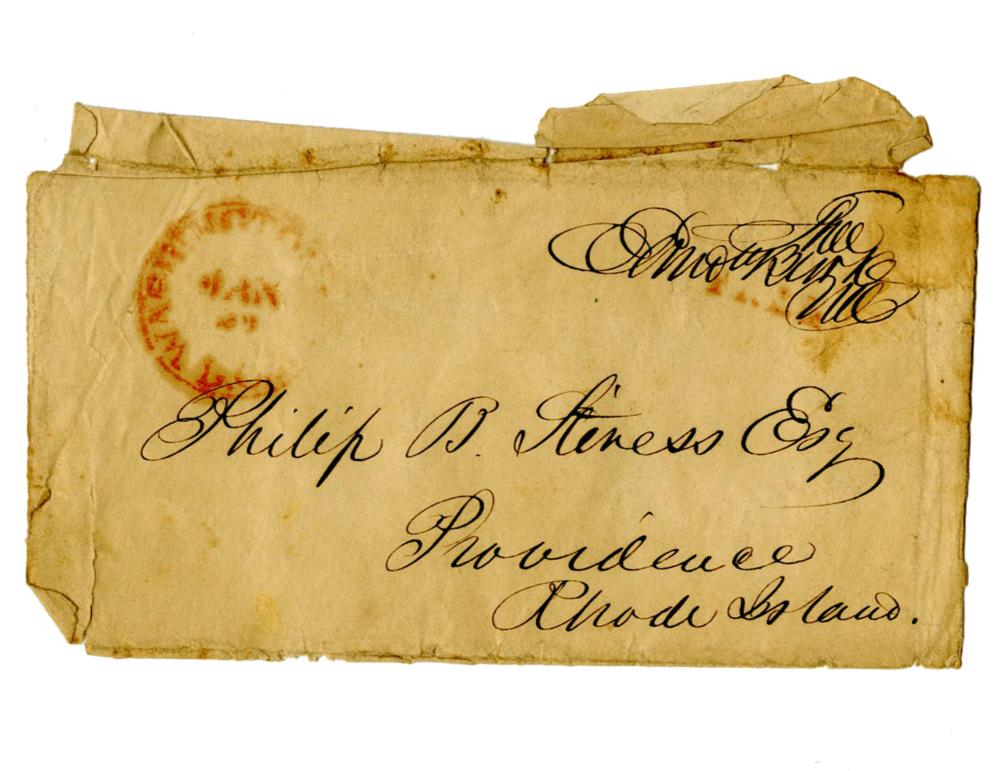
![[Dorr's Rebellion] NH Rep. Edmund Burke Offers "all the assistance in my power" to Thomas Dorr](https://image.invaluable.com/housePhotos/universityarchives/31/788431/H19845-L398134681.JPG)